


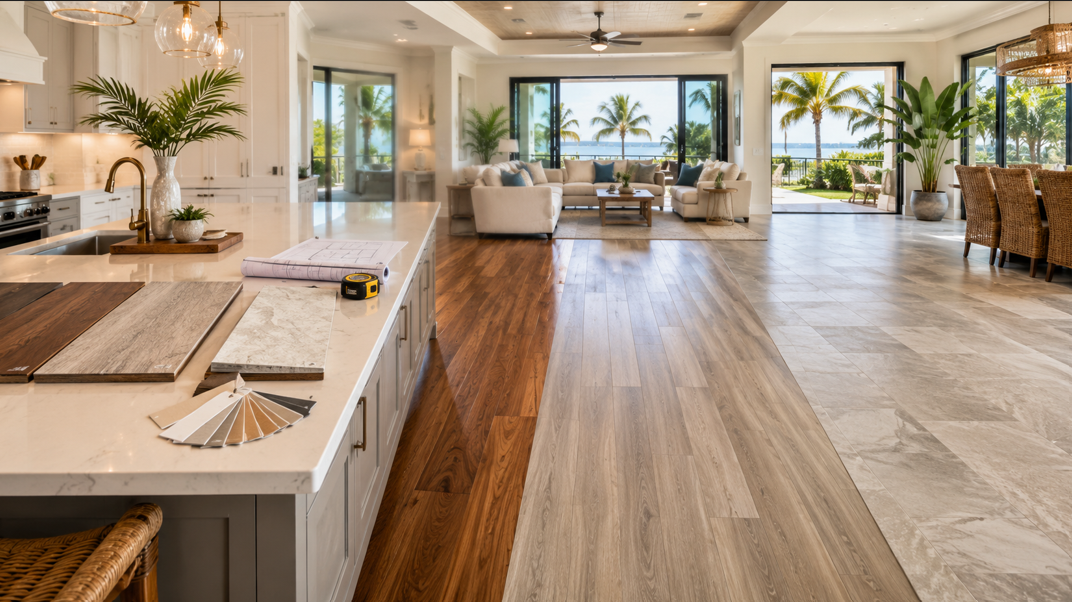
Flooring Cost Is About More Than the Price on the Sample
When planning a remodel, flooring can become one of the largest and most visible investments in the project. It covers a substantial part of the home, influences how every room feels, and needs to perform through years of foot traffic, furniture movement, cleaning, spills, and changing Florida humidity.
That is why comparing flooring by the material price alone rarely tells the full story.
Hardwood, luxury vinyl, and waterproof flooring come with different purchase prices, installation requirements, maintenance needs, repair options, and expected lifespans. A product with a lower starting price may need replacement sooner, while a higher initial investment may deliver decades of use and allow for future refinishing.
Homeowners also need to consider the room itself. A Fort Myers kitchen exposed to tracked-in rain and frequent spills has different needs from a Lakeland bedroom or formal dining room. The right value depends on where the floor will be installed and how the household lives.
Williford Flooring Company Inc. has helped Florida homeowners select and install flooring since 1946. The company’s knowledgeable specialists can explain how product construction, subfloor conditions, room use, and installation details affect the overall project cost. Every installation is completed by a dedicated in-house team rather than subcontractors, helping maintain consistent quality throughout the process.
This comparison breaks down what homeowners are paying for with hardwood, luxury vinyl, and waterproof flooring, including the less obvious expenses that can influence a remodel budget.
What Determines the Total Cost of a Flooring Remodel?
The total cost of a flooring project includes much more than the boxes of material brought into the home.
Two homeowners may choose the same flooring product and receive different project estimates because their rooms require different levels of preparation and finishing work.
Common cost factors include:
Flooring material and product grade
Size and shape of the installation area
Removal of existing flooring
Disposal of old materials
Subfloor inspection and preparation
Moisture testing
Leveling or surface repairs
Underlayment or moisture-control products
Adhesive or installation accessories
Baseboards, quarter round, and transitions
Door trimming
Stair components
Furniture movement
Installation pattern
Labor and finishing details
A simple rectangular bedroom with a clean, level subfloor may require less preparation than an open-plan living area with several doorways, uneven surfaces, and flooring transitions.
The Shape of the Room Matters
Material calculations are based on more than the exact square footage of the room. Additional flooring is normally needed for cuts, fitting, visual selection, and future repairs.
Rooms with angled walls, islands, closets, curved features, or multiple entrances may create more offcuts than a basic rectangular space. Decorative layouts such as herringbone or diagonal installation can also increase material and labor requirements.
Existing Flooring Can Affect the Budget
Removing carpet may involve a different process from removing tile, glued vinyl, or an older wood floor.
Tile removal may reveal cracks, uneven areas, or adhesive residue that needs attention. Glued flooring can require additional labor to produce a clean installation surface.
In some cases, new flooring may be approved for installation over an existing surface. That decision depends on the new product, the condition of the current floor, height clearances, moisture conditions, and manufacturer instructions.
Hardwood Flooring: Higher Initial Investment With Long-Term Potential
Hardwood is often the highest initial investment among the three categories. Homeowners are paying for natural material, skilled installation, visual character, and the possibility of a long service life.
The final cost varies according to whether the floor is solid or engineered, the wood species, plank width, grade, finish, and installation method.
Solid Hardwood
Solid hardwood is made from one piece of wood. It offers authentic grain, natural variation, and the potential to be sanded and refinished multiple times, depending on the thickness and condition of the boards.
The material cost can rise with:
Wider planks
Select or premium grades
Less common wood species
Custom stains
Detailed borders
Decorative installation patterns
Site-finished surfaces
Solid hardwood also requires careful consideration of indoor humidity and installation conditions. Because natural wood responds to changes in moisture, the product needs to suit the room and local environment.
Engineered Hardwood
Engineered hardwood uses a real wood surface over a layered core. This construction can provide greater dimensional stability than traditional solid boards in certain applications.
Its cost varies based on the thickness of the real wood layer, core quality, finish, plank dimensions, and manufacturer.
Some engineered hardwood can be refinished, while thinner products may have limited refinishing potential. Homeowners considering long-term restoration may want to ask how the wear layer affects future options.
Hardwood Installation Costs
Hardwood installation often requires more skilled labor than click-together flooring. Depending on the product and subfloor, boards may be nailed, stapled, glued, or installed using another approved method.
Installation costs can increase when the project includes:
Custom staining
Sanding and finishing on site
Borders or inlays
Herringbone or parquet patterns
Wide-plank layouts
Floor vents that need custom fitting
Stair treads and risers
Repairs to the existing subfloor
Site-finished hardwood involves several stages, including sanding, staining, applying finish, and allowing the coatings to cure. Prefinished hardwood arrives with the finish already applied, which can reduce on-site finishing time.
Long-Term Hardwood Value
One of hardwood’s strongest financial advantages is its restoration potential.
A floor that becomes scratched, dull, or visually dated may be sanded and refinished rather than completely replaced. The stain color and sheen may also be updated when the flooring has enough usable wood remaining.
That restoration potential can extend the floor’s useful life and preserve its natural character.
Hardwood may offer strong value for homeowners who:
Prefer authentic natural materials
Plan to remain in the home for many years
Want future refinishing options
Are updating formal or prominent living areas
Appreciate natural variation and aging
Can maintain stable indoor conditions
The initial investment is higher, but the floor may continue serving the home through several design updates.
Luxury Vinyl Flooring: Accessible Style and Practical Performance
Luxury vinyl is often selected by homeowners seeking a balance of design, durability, and manageable project cost.
It is available in plank and tile formats, with visuals inspired by hardwood, stone, concrete, and other materials. Product prices vary considerably, so luxury vinyl is not one uniform budget category.
What Affects Luxury Vinyl Pricing?
The cost of luxury vinyl may depend on:
Overall plank or tile thickness
Wear-layer construction
Core type
Attached underlayment
Surface texture
Beveled edges
Printed design quality
Pattern repetition
Residential or commercial rating
Warranty coverage
Entry-level products may provide an approachable starting point, while premium products may include more realistic visuals, enhanced surface texture, stronger locking systems, thicker construction, or greater wear protection.
Installation Cost
Many luxury vinyl products use floating click-lock systems. This can make installation more efficient than traditional hardwood, provided the subfloor is suitable.
Some products are glued down instead. Glue-down installation may be preferred for certain commercial spaces, large areas, or applications where rolling traffic and dimensional control matter.
Although click-lock flooring can appear simple, the finished result still depends on accurate preparation. An uneven subfloor may allow planks to move, flex, separate, or experience locking-joint pressure.
Costs may rise if the project requires:
Extensive leveling
Crack repair
Adhesive removal
Moisture-control products
Perimeter or bathroom sealing
Detailed cuts around cabinets
Multiple transitions
Stair installation
Replacement and Repair Considerations
A damaged floating luxury vinyl plank may sometimes be replaced, but access can affect the amount of flooring that needs to be lifted. A plank in the middle of a large room may require more work than one near an exterior edge.
Luxury vinyl cannot usually be sanded and refinished like hardwood. When the surface is deeply worn or the homeowner wants a new appearance, replacement is generally the main option.
That shorter renewal cycle needs to be considered alongside the lower initial cost.
Where Luxury Vinyl Offers Strong Value
Luxury vinyl may suit homeowners who want:
A broad range of colors and styles
A comfortable residential appearance
Easier routine cleaning
A lower starting investment than many hardwood products
Flooring for active family or pet areas
Consistent design across several rooms
Faster installation than a site-finished wood floor
It can be especially practical in remodels where homeowners want to update a larger area while keeping the project budget balanced.
Waterproof Flooring: Paying for Greater Moisture Protection
Waterproof flooring often overlaps with luxury vinyl because many luxury vinyl plank and tile products use waterproof cores.
However, the term describes a performance feature rather than one single flooring material. Homeowners may encounter waterproof rigid-core flooring, waterproof luxury vinyl, and selected products from other categories.
The cost depends on construction, wear rating, finish quality, and installation requirements.
What the Waterproof Label Covers
A waterproof flooring material is designed not to absorb water under the conditions stated by the manufacturer. That can make it valuable in kitchens, laundry rooms, bathrooms, entryways, and other spaces where spills or dampness are more likely.
The label does not mean the entire room is protected from flooding.
Water can still reach:
The subfloor
Underlayment
Baseboards
Drywall
Cabinets
Wall cavities
Adjacent rooms
A waterproof plank can survive moisture while surrounding building materials experience damage.
Why Some Waterproof Products Cost More
Premium waterproof products may include:
Stronger rigid cores
Thicker wear layers
Enhanced surface coatings
More detailed wood or stone visuals
Embossed textures
Attached acoustic padding
Commercial performance ratings
Improved locking systems
Longer or broader warranty coverage
These features can affect comfort, appearance, sound, stability, and resistance to everyday wear.
Homeowners comparing hardwood flooring with vinyl and waterproof options may find that the least expensive product is not automatically the best value for every room. The right comparison includes expected use, maintenance, future repair, and how long the floor is intended to remain in place.
Installation Still Influences Waterproof Performance
A waterproof product needs to be installed according to its approved system. Planks that are not fully locked, an uneven subfloor, incorrect expansion spacing, or unsuitable accessories may affect the floor’s performance.
Some manufacturers also require specific perimeter details in bathrooms, laundry rooms, or kitchens.
Waterproof flooring may provide strong value for households that need:
Greater protection from everyday spills
Flooring near exterior entrances
Easy maintenance in active rooms
A wood-inspired appearance in moisture-prone spaces
Consistent flooring through kitchens and living areas
Practical surfaces for children and pets
Comparing Upfront Cost
In general, standard luxury vinyl often has the lowest initial project cost, waterproof rigid-core flooring sits in a broad middle range, and hardwood requires a higher initial investment.
That order can change depending on the selected product.
A premium waterproof plank may cost more than an entry-level engineered hardwood. A custom wide-plank hardwood installation may cost considerably more than a straightforward vinyl project. Extensive preparation can also narrow the gap between materials.
A realistic estimate needs to compare products with similar quality levels rather than placing the most basic vinyl beside a premium hardwood.
Lowest Starting Investment
Luxury vinyl frequently offers the most accessible starting point, particularly for straightforward rooms and floating installations.
It may allow homeowners to update more square footage within the same immediate budget.
Mid-Range Investment
Waterproof rigid-core flooring often falls in the middle, although premium collections can reach higher price levels.
The additional cost may reflect stronger construction, enhanced visuals, attached padding, or greater moisture performance.
Highest Starting Investment
Hardwood normally carries the highest initial cost because of the natural material, installation skill, and finishing requirements.
The benefit is a floor that may last much longer and can potentially be renewed rather than replaced.
Comparing Long-Term Costs
Upfront price tells homeowners what the project costs today. Long-term cost considers what may happen throughout the floor’s useful life.
Hardwood Over Time
Hardwood may require periodic professional maintenance or refinishing, but it can remain in the home for decades when suitable products are installed and maintained correctly.
A refinishing project is an additional future expense. However, it may cost less than removing and replacing the entire floor, and it keeps the original wood in place.
Luxury Vinyl Over Time
Luxury vinyl usually requires straightforward routine cleaning and does not need sanding or refinishing.
When it becomes deeply scratched, damaged, or visually worn, individual repair or full replacement may be considered. The cost is lower at the beginning, but homeowners may replace it sooner than well-maintained hardwood.
Waterproof Flooring Over Time
Waterproof flooring can reduce concern about ordinary surface spills, which may help avoid certain moisture-related replacement costs.
It still needs protection from scratching, heavy impacts, extreme heat, and prolonged hidden leaks. Like other vinyl-based flooring, it cannot normally be refinished.
The long-term value depends on product quality, room use, installation, and how quickly the homeowner would otherwise replace the floor for style or performance reasons.
Maintenance Costs and Everyday Care
Routine care adds to the true ownership cost, although it may not appear in the installation estimate.
Hardwood Maintenance
Hardwood typically benefits from:
Regular dust removal
Prompt spill cleanup
Manufacturer-approved wood-floor cleaner
Protective pads beneath furniture
Mats near exterior entrances
Indoor humidity management
Periodic professional assessment
Future recoating or refinishing when needed
Steam cleaners, excess water, and unsuitable products may affect the finish or wood.
Luxury Vinyl and Waterproof Maintenance
Vinyl-based floors are generally easy to maintain with regular sweeping or vacuuming and damp cleaning using approved products.
Homeowners may still need:
Protective furniture pads
Mats with compatible backings
Prompt spill cleanup
Care when moving heavy objects
Protection from sharp pet claws or gritty debris
Cleaning products approved for the finish
Waterproof does not mean maintenance-free. Routine care protects the visual surface and helps the flooring retain its appearance.
Repair and Replacement Costs
Accidents happen, and the ability to repair a floor can change its long-term value.
Hardwood Repairs
Hardwood offers several repair possibilities depending on the damage:
Replacing individual boards
Screening and recoating the finish
Sanding localized areas
Refinishing the entire room
Adjusting the stain color
Repairing scratches or dents
Natural variation can also help new repair boards blend into the existing floor, although exact color matching is not always possible.
Vinyl and Waterproof Repairs
Individual planks may be replaceable, but the process depends on the installation method and location of the damage.
Floating floors may need to be disassembled from the nearest wall. Glue-down products may allow localized removal, but adhesive and subfloor preparation require care.
Keeping a small quantity of original material after installation can make future repairs easier because product colors and collections may change.
Which Flooring Offers the Best Value by Room?
The best financial choice may differ from one room to another.
Living Rooms and Dining Rooms
Hardwood can offer strong long-term value in prominent gathering areas where natural beauty and refinishing potential matter.
Luxury vinyl or waterproof flooring may suit active households that prioritize easier cleaning and a lower initial investment.
Kitchens
Waterproof flooring is often appealing because kitchens face spills, plumbing connections, and frequent cleaning.
Hardwood can still be considered when homeowners understand the care requirements and choose a suitable product and installation system.
Bedrooms
Bedrooms usually experience less moisture and lower foot traffic. Hardwood, engineered wood, and luxury vinyl can all work well depending on comfort, style, and budget.
Bathrooms and Laundry Rooms
Waterproof flooring generally offers more practical protection in these areas.
The selected product needs to be approved for the specific installation. Flooring marketed as waterproof is not automatically suitable inside a shower or another continuously wet area.
Entryways
Waterproof or durable luxury vinyl can offer good value where rainwater, sand, and outdoor debris enter the home.
A strong wear layer and suitable surface texture may matter as much as moisture resistance.
Whole-Home Remodels
Using one material throughout several spaces can create visual continuity and may simplify purchasing.
However, homeowners do not always need one flooring type everywhere. A remodel might combine hardwood in living and bedroom areas with waterproof flooring in laundry rooms, bathrooms, or busy entrances.
Transitions need to be planned carefully so the home still feels coordinated.
How to Set a Practical Flooring Budget
A useful flooring budget includes room for preparation and finishing details rather than assigning every dollar to the product itself.
Measure the Entire Project Area
Include closets, connecting halls, and adjoining spaces that may need matching flooring.
Build in Material Allowance
Additional material is normally needed for cuts, visual selection, and future repair stock.
The required amount varies by room shape, installation pattern, and product.
Reserve Funds for Preparation
Subfloor conditions are not always fully visible until the existing flooring is removed. Setting aside part of the budget for leveling, moisture control, or repairs can keep the project moving smoothly.
Compare Complete Estimates
A useful estimate clearly identifies what is included, such as:
Material
Removal
Disposal
Preparation
Installation
Underlayment
Adhesives
Trim
Transitions
Furniture moving
Stairs
Finishing work
A lower estimate may exclude services that appear later as separate charges.
Consider How Long You Plan to Stay
Homeowners planning a long-term residence may place more value on hardwood’s longevity and refinishing potential.
Those preparing a property for sale or completing a faster renovation may prefer the accessible style and installation efficiency of luxury vinyl or waterproof flooring.
Choosing the Right Investment for Your Lakeland or Fort Myers Remodel
Hardwood, luxury vinyl, and waterproof flooring each offer a different type of value.
Hardwood usually requires the largest initial investment, but it provides authentic natural character, long-term service, and potential refinishing options. It may be the strongest choice for homeowners who want a lasting architectural feature.
Luxury vinyl often offers the most approachable starting cost. It provides broad design flexibility, practical maintenance, and efficient installation for many residential rooms.
Waterproof flooring can cost more than basic vinyl, but the added moisture protection may justify the difference in kitchens, laundry rooms, bathrooms, entryways, and pet-friendly areas.
The best choice is not simply the least costly floor or the most premium product. It is the flooring that fits the room, household activity, expected ownership period, maintenance preferences, and complete remodel budget.
Williford Flooring Company Inc. can help homeowners compare samples, construction, installation requirements, and long-term value before making a selection. Its experienced in-house installation team also helps ensure that preparation and finishing details receive careful attention.
For help planning the flooring budget for your Lakeland or Fort Myers remodel, we are here to help.


